




Large Cork Yoga Blocks – 9x6x3 inch, Custom Logo from the Factory Floor
Sizes: standard 9 × 6 × 3 inches, or custom-cut to your drawing up to 12 inches.
Material and finish: pressed from natural cork granules and sanded to a fine surface.
Branding: in-house logo branding starts at 300 units.
MOQ: 200 pcs for stock items.
Sampling: 5–7 days.
Description
Technical Parameters
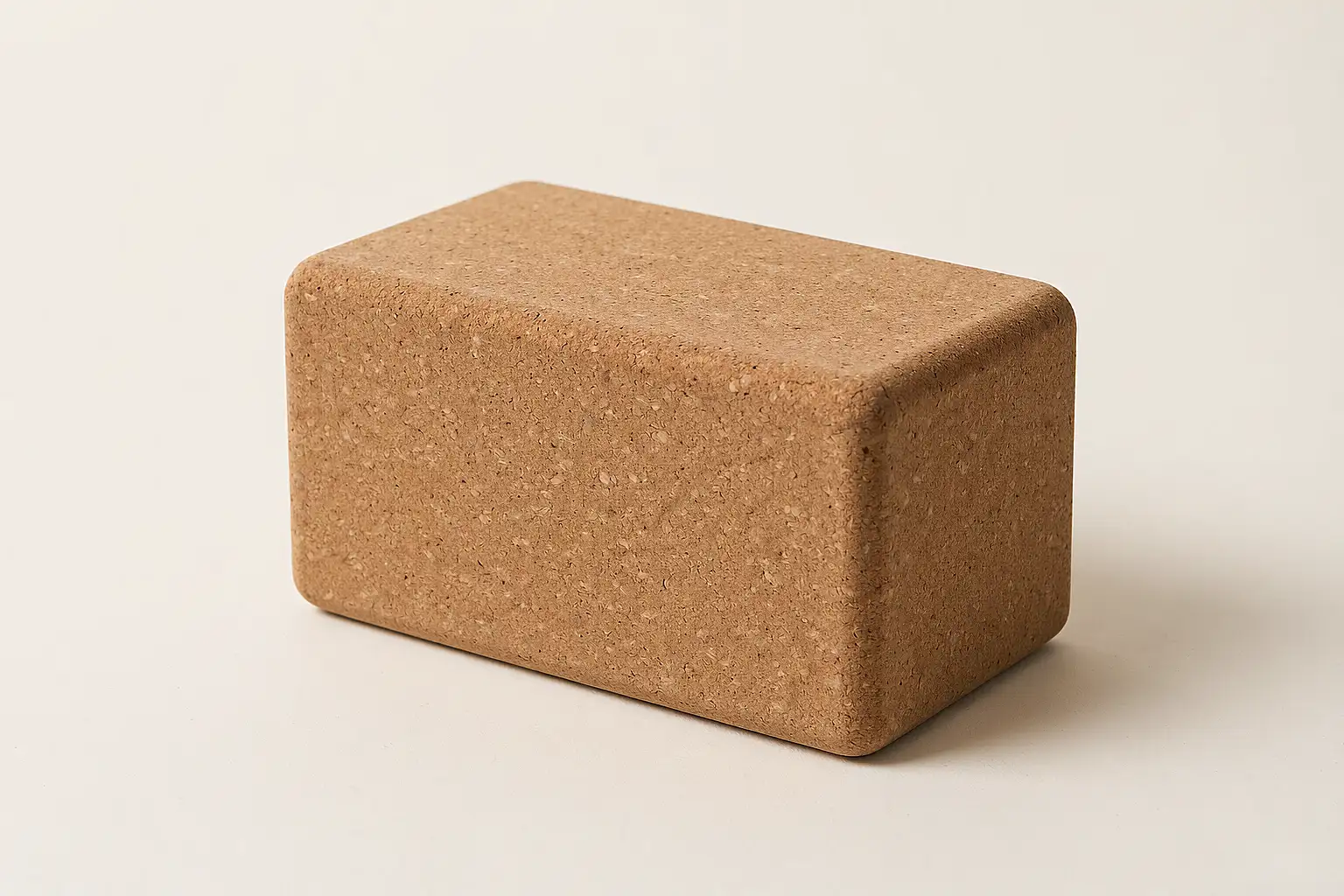
Standard cut 9 × 6 × 3 inch (22.5 × 15 × 7.5 cm) - pressed cork granules, fine-sanded faces, rounded edges.
Six rows, ten seconds, no email required
| Material | Pressed natural cork granules, sanded smooth |
| Standard size | 9 × 6 × 3 inch (225 × 150 × 75 mm), tolerance ±0.1″ (±2.5 mm) |
| Logo method | Laser engraving · heat transfer · debossing |
| MOQ | 200 pcs stock / 300–500 pcs custom |
| Lead time | Sample 5–7 days · Bulk 30 days |
Technical Specifications
| Material | Natural cork granules, pressed and fine-sanded |
| Standard size | 9 × 6 × 3 inch (225 × 150 × 75 mm) |
| Custom sizes | Up to 12 inch tall; 9 × 6 × 4 inch and 10 × 7 × 5 inch are popular customs |
| Tolerance | ±0.1 inch (±2.5 mm) on every cut edge |
| Weight | 820–1000 g per block |
| Density | 320–400 kg/m³ - must close with the weight row (grams ÷ 2,531 cm³) |
| Surface | Fine-sanded faces, rounded edges |
| Logo options | Laser (depth 0.5 mm, min line 0.3 mm) · heat transfer (full color) · deboss (1–2 mm) |
| MOQ | 200 pcs (stock) / 300–500 pcs (custom) |
| Sample | Free sample, freight collect |
| Bulk lead time | 30 days after deposit and artwork approval |
| Monthly capacity | blocks / month (this product line) |
| Packaging | Blocks are individually wrapped and edge-protected; export cartons are palletized and strapped for full-container orders |
Which block fits your practice?
Measurements assume the standard 9 × 6 × 3 inch cut. For anything outside the list, send a drawing; we confirm sizing before sampling.
| Your use case | Recommended block | Why |
|---|---|---|
| Hot yoga studio, high sweat | 9×6×3″ standard | Full 6″ width under palms; cork grips harder when damp |
| Restorative / Yin | 9×6×4″ or taller, custom | Extra height supports deep folds without stacking |
| Kids & yoga therapy | 9×6×3″ standard | The 3″ lift keeps young wrists in a safe range |
| Meditation seat | Two 9×6×3″ side by side | 12″ combined width matches sit-bone width |
| Retail 2-pack | 2 × 9×6×3″, kraft sleeve | Pack weight just under 2 kg, shelf-ready |
| Other | Send a drawing or one sample - we confirm sizing before sampling. | |
Material options - and when not to buy cork
| Type | Best for | Cost | What to know |
|---|---|---|---|
| Natural cork block (this page) | Grip, sustainability, premium retail | $$ | Heavier than foam (~0.9 kg); natural shade varies slightly batch to batch |
| EVA foam | Budget studio chains | $ | Compresses unevenly under load, degrades with sweat |
| TPE / rubber | Lowest retail price point | $ | No wood grain, not biodegradable, turns slick when wet |
| Cork-face composite | Dyed or two-tone programs | $$$ | Only if you need colors cork can't give; adds lead time |
If your program is pure price-driven retail, foam or TPE will beat us. If grip under sweat and a natural-material story matter, cork wins. That is the honest boundary.
What each branding method actually does
Laser engraving
Burns 0.5 mm into the surface, so the mark is part of the block, not a layer on it. Best for one-color marks and fine detail.
Heat transfer printing
Full-color CMYK/Pantone artwork with a scratch-resistant laminate, up to 150 × 100 mm on a flat face.
Debossing
A 1–2 mm pressed recess, no ink, no color. Minimalist marks in the material itself.
Six problems we engineered out
A block that passes on the bench and wobbles on the floor.
Problem 1 · Flatness
1. Flatness at the cut
A fresh batch looks fine on the packing bench. Then the first student plants a hand on it during a studio demo - and the block rocks. Stack two, and the error doubles.
The cause is cut-edge flatness: at the standard ±0.1 inch (±2.5 mm) tolerance, a poorly controlled cut leaves one corner up to 5 mm proud across a pair. We hold ±2.5 mm on every edge and check flatness against a ground plate at the line.
How to check us: a straightedge and one minute per block. Any corner gap over 2.5 mm is a claim.
Forty minutes into a heated class, hands are wet.
Problem 2 · Wet grip
2. Hot yoga, damp palms, and a block that still grips
A foam block skates across the mat on a Warrior III transition. Cork behaves the other way: its suberin-rich cellular structure forms a micro-texture that raises friction as moisture rises. The damp-hand grip is a material property, not a coating that wears off.
We leave the grip faces unsanded beyond the finishing grit and apply no film or polish to them.
How to check us: rub damp palms on a sample. It should grip harder wet than dry. Like bark, not plastic.
"It sheds onto students' hands within a term."
Problem 3 · Edge integrity
3. The crumbling edge nobody blames on the right cause
Our first instinct was the adhesive. It wasn't. Edge crumbling traces to pressing parameters at the block perimeter: pressure and moisture cure the center but leave a soft rim.
The fix lives in the press, not in more glue: pressure and moisture are tuned at the block perimeter, followed by edge sanding that removes the soft rim entirely.
How to check us: run a thumb firmly along any edge of the sample. No granules should shed onto your hand.
"High-density" is easy to print and hard to prove.
Problem 4 · True density
4. 320–400 kg/m³ - a number you can weigh
That is the honest density of a pressed granule block, and it carries a consequence: a 9 × 6 × 3 inch block is 2,531 cm³, so grams ÷ 2,531 must land inside the density figure we print.
If a supplier quotes "high-density" without publishing weight, the claim is unverifiable. Density is exactly what keeps a block from feeling hollow under a full-body load.
How to check us: a kitchen scale. Weigh any block; the math closes or it doesn't.
"The logo was half gone by spring."
Problem 5 · Branding wear
5. Why we recommend laser for daily-use blocks
We hear this about surface-printed blocks every season. Print sits as a layer on top of the cork; block faces take palm and floor abrasion every class, and a decorative layer loses to that.
This is why we recommend laser engraving (0.5 mm deep, so the mark lives inside the material) for blocks in daily studio use, and keep heat transfer for retail programs where the block is displayed more than handled.
How to check us: scratch an engraved area with a coin. The mark doesn't lift; there is no layer to lift.
Studio seasons don't move for production queues.
Problem 6 · Delivery window
6. September 1 is fixed.
Cork-block demand peaks in Q3–Q4, and a "we'll get to it" PO in August arrives after the fall opener. We reserve line capacity against a confirmed PO date, and standard bulk runs complete in 30 days.
How to check us: ask for your production slot confirmation with the sample approval. The date is on paper before the deposit.
Where large blocks go to work
Hot yoga & Vinyasa studios: high-sweat grip; standard 9 × 6 × 3″
Restorative & Yin programs: 12″ custom height replaces stacked pairs
Physiotherapy & rehab clinics: the standard 3″ lift keeps range-of-motion work low-impact
Home practice & e-commerce brands: 2-pack kraft-sleeve programs
Corporate wellness & gyms: laser-engraved facility marks
The case for large-format cuts: a tall student grounding a palm beside the front foot in Triangle needs the full 6″ width - standard narrow blocks force awkward wrist angles.

In studio use: the 3″ lift under the hands keeps wrists neutral; the cork surface grips harder as hands get damp.
From drawing to delivery
Drawing or sample review: sizing and artwork confirmed before sampling
Sample: free sample, freight collect, 5–7 days
Approval & deposit: artwork locked, production slot confirmed; payment by T/T
Bulk production: 30 days
Shipment: FOB Qingdao
Packing list and compliance documents are provided per order with the quotation.
The factory behind the block
Xi'an Tianlei Rubber Technology Co., Ltd. runs a 22,000 m² plant with production lines covering 15+ product types. The company was established in 2007 and exports to 40+ countries. We press the granules, sand the slabs and brand the blocks in-house.
2007Established
22,000 m²Plant
15+Product line types
40+Countries
Questions buyers actually send us
Can you match my studio's current block?
Yes. Send a drawing or one physical sample; custom cuts up to 12 inch with ±0.1 inch tolerance. Sampling starts after sizing is confirmed in writing.
Do you make lower or thinner blocks?
Yes. 9 × 6 × 3 inch and other cuts are routine. Lower lifts suit kids' programs and therapy work.
What is the block made of?
Pressed natural cork granules. No foam filler, no synthetic surface layer. The full material specification sheet is provided with every order.
How fast can I get a sample?
Free sample, you cover freight; 5–7 days after spec confirmation.
What's the bulk lead time in peak season?
30 days after deposit. Q3–Q4 is peak; capacity is locked by PO date, not by intent.
How do I verify the density claim?
Weigh a block on a kitchen scale. A 9 × 6 × 3 inch block is 2,531 cm³, so grams ÷ 2,531 must land inside the printed kg/m³ figure.
Do you have CE certification?
Yoga blocks fall outside every CE directive, so we don't claim CE. Per order we provide the documents that do apply: ISO 9001:2015 certificate and material test reports.
How are blocks packed for export?
Blocks are individually wrapped and edge-protected, then packed in double-wall export cartons; full-container orders ship palletized and strapped.
Which port do you ship from?
FOB Qingdao.
Hot Tags: Large Cork Yoga Blocks – 9x6x3 inch, Custom Logo from the Factory Floor, China Large Cork Yoga Blocks – 9x6x3 inch, Custom Logo from the Factory Floor manufacturers, suppliers, factory, Natural Cork Ball, Cork Squat Wedge, Cork Brick, Natural Cork Wedge, Cork Yoga Ball, Tpe Cork Yoga Mat
Previous
best cork yoga matNext
cork foot rollerSend Inquiry


