




Cork massage ball — one piece, no core

Cork massage ball — one piece, no core

Cork massage ball — one piece, no core

Cork massage ball — one piece, no core

Cork massage ball — one piece, no core

Cork massage ball — one piece, no core

Cork massage ball — one piece, no core

Cork massage ball — one piece, no core
Cork massage ball — one piece, no core
Diameter range: Ø50–75 mm.
Pressed in one piece from cork granule at 320 or 450–550 kg/m³
One-piece pressed cork granule construction, with density of 320 kg/m³ or 450–550 kg/m³.
No bladder, no foam core, no PVC.
No bladder, no foam core, and no PVC.
No seam to open in year two.
No seam that can open in the second year.
36 to 150 mm to drawing.
Sizes from 36 to 150 mm can be made to drawing.
A ball that gives way and a ball that doesn't are different products, and we press both.
A ball that gives way and a ball that does not are different products, and both are pressed.
That's why you'll see two densities and not one with a checkbox.
That is why two densities are offered, not one density with a checkbox option.
Ø50–75 mm · 36–150 mm to drawing
Size summary: Ø50–75 mm, or 36–150 mm to drawing.
200 pcs
Quantity: 200 pcs.
±0.5 mm
Tolerance: ±0.5 mm.
2007 established
Established in 2007.
22,000 m² site · 12,000 m² roofed
Site area: 22,000 m²; roofed area: 12,000 m².
15 production lines.
40+ countries
Serving 40+ countries.
500,000 pcs a month off the ball line
Monthly capacity of the ball line: 500,000 pcs.
Description
Technical Parameters
If a line here would not have come up in the first email, it does not belong.
| Material | Cork granule pressed in one piece. No bladder, no foam core, no PVC. |
| Diameter | Ø50 / 60 / 65 / 70 / 75 mm standard, 36–150 mm to drawing, ±0.5 mm |
| Density | 320 kg/m³ soft · 450–550 kg/m³ firm |
| Weight | Ø50 21 g · Ø60 36 g · Ø70 58 g · Ø80 86 g, all at 320 kg/m³, all weighed |
| Logo | Laser engraving, screen print, pad print, hot stamp |
| MOQ | 200 pcs, with your logo on it |
| Lead time | Sample 3 days from stock, 10 days custom. Order 15 days stock, 25 days custom. |
Everything we are prepared to put a number against.
| Material | Agglomerated cork from Quercus suber bark granule |
| Structure | One-piece press, no core, no seam |
| Granule | 0.5–1 mm on the fine grade - see the note below the table |
| Standard diameters | 50 / 60 / 65 / 70 / 75 mm |
| Custom diameter | 36–150 mm to drawing |
| Peanut ball | 65 × 135 mm · 73 × 155 mm |
| Diameter tolerance | ±0.5 mm |
| Peanut length tolerance | ±1 mm |
| Density | 320 kg/m³ soft · 450–550 kg/m³ firm |
| Hardness | 60–65 Shore A at 450–550 kg/m³ |
| Unit weight | Ø50 21 g · Ø60 36 g · Ø70 58 g · Ø80 86 g, at 320 kg/m³ |
| Moisture at pressing | ≤ 8 %, ±1 %, read before the press, not after |
| Binder | Eco-grade. The 320 grade carries more of it than the firm grade. |
| Surface | Sanded. Oil or wax if you ask. Frosted and decal on request. |
| Logo methods | Laser engraving from 200 pcs · screen print · pad print · hot stamp |
| MOQ | 200 pcs, including custom logo |
| Sample lead time | 3 days from stock · 10 days custom |
| Bulk lead time | 15 days from stock · 25 days custom, from deposit |
| Capacity | 500,000 pcs a month on the ball line |
| Packaging | Carton count, carton size and pallet quoted against your diameter and logo method |
| Payment | 30 % T/T deposit, 70 % against copy of B/L |
We publish four weights because we've put four molds on the scale. Ø65 isn't one of them - it's the computed figure between Ø60 and Ø70, 46 g at 320 kg/m³. That's what makes the 200-piece carton 9.2 kg. If you need the real number before you book freight, say so and we'll weigh that mold. Ten minutes.
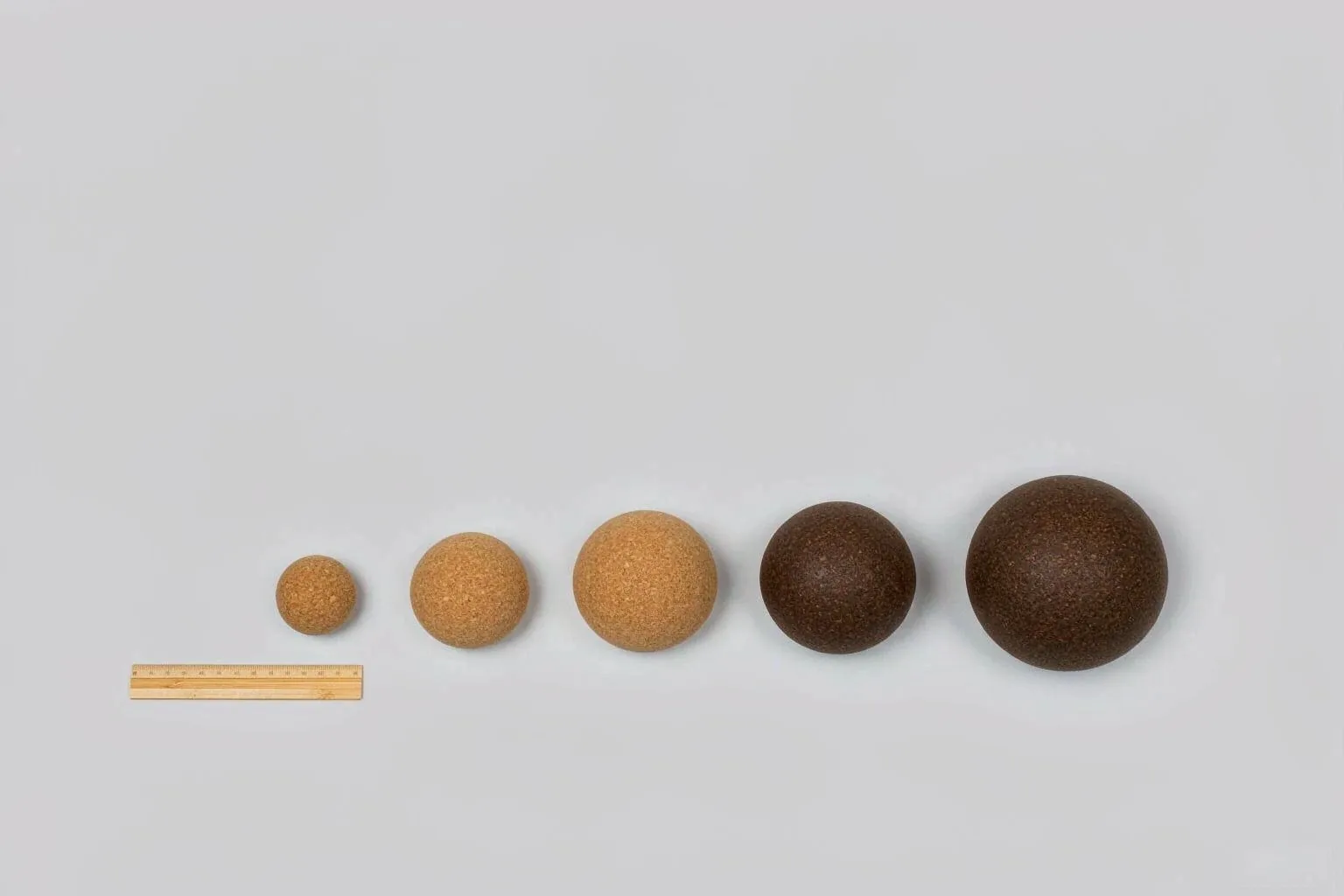
Five molds, one steel rule. The two darker balls are a finish sample - ask what they are before you assume a colour range.
The job picks the diameter. Not the other way round.
Half the enquiries we get name a size before anyone says what the ball is for. Tell us the use case and we'll send one back.
| Your case | Diameter | Density | Why |
|---|---|---|---|
| Plantar fascia, one trigger point | 60–70 mm | 450–550 | Small patch, high pressure. Past 70 mm you've lost the arch. |
| Neck and shoulder, thin client | 75–80 mm | 320 | Spreads the load, rolls beside the spine without catching bone. |
| Yoga prop, palm support | 65 mm | 450–550 | Sits in a palm and stays there under a supporting hand. |
| Rehab, elderly, children | 80–100 mm | 320 | Low pressure. Less bruising on thin skin. |
| Wall work, on a mat | 60 mm | 450–550 | Small ball positions better between a body and a hard surface. |
| Beside the spine | 65 × 135 mm peanut | either | The waist clears the spinous process; both lobes work the erector spinae. |
| Hamstring, IT band, calf | 73 × 155 mm peanut | 450–550 | Longer span, one pass covers more muscle. |
| Something else | Send the drawing or a sample. | We confirm density and wall thickness before sampling. | |
Your spec sheet wins over this table. We make to drawing.

Ø65 at 450–550, arch work. The ball doesn't slide because sanded cork grips a floor.
Two positions on a shelf.
Ask for something between 320 and 450 and we're talking about your spec sheet, not a catalogue number.
| Best for | Feel | What to know | |
|---|---|---|---|
| 320 kg/m³ soft | Rehab, elderly, children, work beside the spine | Gives, then comes back | Slower rebound. Park something heavy on it for a month and it takes a flat spot. This grade carries more binder than the firm one. We call it pressed granule with binder. |
| 450–550 kg/m³ firm | Trigger points, arch, palm, wall | Hard, not cold | It will find a tender spot and it won't apologise. On a thin client it can bruise. |
| TPE / EVA / silicone | Cheap programmes, wide colour range, very soft grades | Soft and uniform, any colour you want | Holds sweat and starts to smell. Slides on a wooden floor. Out of shape inside a year, and no grain to grip with. |
| Hollow cork shell | Light, cheap, gift programmes | Light in the hand, hollow sound | Deforms at the seam. Six months in it isn't round, and a ball that isn't round won't stay where you put it. |
One thing about the word natural. Cork granule needs a binder to hold its shape. There isn't a pressed cork ball on the market that skips it, and a supplier claiming otherwise is describing another process or another material. The difference between our two grades is how much binder goes in. That's the whole story.
And cork is bark, not wood. Nobody cuts the tree. The bark comes off every nine years and grows back, which is why the material exists at all.

Granule and open pores under raking light. The dark network between flakes is the binder; the pale pieces are cork from the inner bark.
Every supplier lists the methods. Almost none lists the limits.
And the limits are what you need before you approve artwork.
Laser engraving
Burns the face. Charred brown on brown, no colour, permanent.
Limit: fine text under 0.3 mm fills in and reads as a smudge.
01
Screen print
One or two colours, readable at arm's length.
Limit: on a curved face it needs a fixture, and registration drifts about ±0.5 mm between passes. The edge wears first on the side that meets the floor.
02
Pad print
Sharper than screen print at small sizes, good on a tight curve.
Limit: same colour-count ceiling, and large solid areas come out with pinholes.
03
Hot stamp
Foil, reads as premium on a shelf.
Limit: cork isn't flat, so the foil won't seat evenly. Simple shapes only, and the edges lift with handling.
04
Spray / decal
Full colour, Pantone matching.
Limit: the spray covers the grain, which is the reason people buy cork in the first place. Decal edges lift in a humid warehouse.
Screen print, pad print and spray are quoted per design, because the minimum depends on how many passes your artwork needs. Send the file and you'll have the number today.
Before the ball reaches your customer.
01
Same size, different feel
Two Ø60 balls on a shelf. Same colour, same weight in the hand, same carton. One is a support under your arch. The other is a stone.
Density, not diameter. The mold decides the size and the mold doesn't wander. What varies is how much cork went into the same volume.
And it starts on your purchase order. Write "cork massage ball, Ø60" and nothing else, and you'll get whatever density was in the warehouse that week - usually the cheapest one. Put the density in the line item. Two extra words, and the conversation about "the second batch feels different" never happens.
Check any supplier: ask what you'd get if you ordered the same diameter twice and specified nothing else. A factory that makes both grades will say it depends on stock. That's your answer.
02
Over the half millimetre
Thirty balls on a studio shelf, seen from the door. On one ball, half a millimetre is invisible. In a set, it's the difference between a product and a return marked "not the same".
We hold ±0.5 mm. Sets get packed out of a single batch, never across two. That's a packing rule, not a quality claim, and most suppliers skip it because it costs them a partial carton.
Check us: stand a set on a flat table and look along the line from table height. A ball that breaks the line here breaks it in your customer's hands.
03
The second order that doesn't feel like the first
We've heard that sentence, and our own first guess was always the diameter. It's almost never the diameter.
It's moisture. Cork pulls water out of the air. Granule pressed at 10 % and granule pressed at 7 % don't end up the same object, even when the density reading matches on the day. You find out three weeks later, in the customer's hands, not in our inspection room.
We press at ≤ 8 %, ±1 %, and the reading comes before the press.
Check any supplier: ask for density and moisture together. A spec that names one and not the other is half a spec, and the missing half is the one that moves between orders.
04
Nine point two kilograms
200 Ø65 balls at 320 kg/m³ is 9.2 kg. One express carton. No pallet, no LCL booking, no waiting for someone else's container to fill.
That's what a minimum order actually means. 200 sounds like a number. 9.2 kg is a decision - it tells you the freight, the delivery window, and whether you can test a market before you commit to a container.
The same 200 in Ø80 comes to 17.2 kg. Still one carton, nearly double the freight, identical tooling cost and identical minimum. Neither figure is wrong. They're different products, and your forwarder quotes on the weight.
Check any supplier: get the carton weight before you pay the deposit. Anyone can quote a piece count. The weight is the part that costs money.
05
Does it shed?
It comes up in almost every first call, and it deserves an answer instead of a reassurance.
Pressed cork sheds at a sharp edge under friction. That's the material doing what cork does. Any supplier who tells you their cork never sheds has either not tested it or is selling you a coated ball.
What we control is the edge. Balls get sanded after pressing so there's no sharp arris left to break down, and the surface stays unfinished unless you ask for oil or wax. A coating hides the grain and moves the dust to week nine.
Check us: press one hard and roll it fifty times over white paper. Whatever lands on the paper is what ends up in your customer's gym bag.
06
There is no core
Most massage balls at this size are TPE, EVA, silicone, or a cork shell wrapped around a plastic core. The shell version is cheaper and lighter and it reads fine on a spec sheet. It also deforms at the seam, and a seam can't be fixed later.
Ours comes out of one mold, pressed from granule under heat and pressure. Nothing inside to collapse, because there is nothing inside.
We cut one in half and put it in the sample box. Not a rendering - the ball you were about to buy, opened.
Check any supplier: weigh it first. Ø65 at 320 kg/m³ is 46 g. A hollow shell of the same size comes in around a third of that. The scale tells you what's inside before anyone has to cut one open.

Our own ball, cut through the middle. Granule and binder from the surface to the centre - no shell, no cavity, no white core.
Five buyer types, five different specifications.
| Buyer | What they order | Typical spec |
|---|---|---|
| Yoga and Pilates studios | Class props, retail add-on | Ø65 at 450–550, logo laser-engraved |
| Physio and chiropractic clinics | Professional myofascial tools | Ø60 and Ø75, firm, no logo |
| Fitness distributors | An eco SKU beside TPE and foam | Ø70 at 450–550, logo printed on the carton |
| Corporate wellness | Branded sets | Ø65 at 320, screen print |
| Private label | Full range under own brand | Ø50–80, mixed densities, own carton |

Studio shelf: three sizes, one material. Composite image - see the placement note before publishing.
Step two is where the dates get decided.
1. Spec.Diameter, use case, logo file, a packaging reference.
2. Confirm.You get the density and the tolerance back, plus a date that holds.
3. Sample.A physical sample ships: 3 days out of stock, 10 days for a custom run.
4. Deposit.30 % T/T books the slot. 70 % against copy of B/L.
5. Production.Press, sand, print, pack. 15 days from stock, 25 days custom, counted from deposit.
A date that fits your spec beats a headline number that only holds for one diameter and one logo method. Carton count, carton size and pallet come with the price, not after it. Send the diameter and the logo file.
Xi'an Tianlei Rubber Technology, 2007.
22,000 m² of site, 12,000 m² under roof, fifteen lines, freight out to more than forty countries. The ball line alone runs 500,000 pieces a month.
No.3, Tuanjie Rd., Ind. Park, Caotang Town, Xigao New Huyi Dist., Xi'an, Shaanxi, China
Plant, or a trading desk with a rented address? A photograph won't settle that. We're forty minutes from Xi'an Xianyang airport. Tell us the week you're travelling and we'll put you beside a running press with a caliper and a diameter of your choosing off the shelf. Bring your own gauge if you'd rather.
On paperwork, there are no certification logos on this page. Tell us what your file needs - a management-system certificate, a material declaration, a test report for a specific market - and we'll tell you what we hold and what we don't, in writing, before you order. A logo on a product page isn't a document. It's a picture of one.
Batch questions go to the production manager who signs the inspection sheet. Ask for the name on your first order and you'll have a person, not a portal.
Thirteen answers, no asterisks.
What diameters do you make?
50, 60, 65, 70, 75 mm standard. 36 to 150 mm to drawing, ±0.5 mm.
Which density for plantar fascia work?
Firm, 450–550 kg/m³, at 60–70 mm. Small contact patch under high pressure is the whole point. Past 70 mm the ball stops reaching the arch and starts spreading the load.
Can you make a size that isn't listed?
Yes, up to 150 mm, from a drawing or a sample. We confirm density and wall thickness first, because those two decide whether a custom size behaves like a standard one.
Do you make peanut balls?
65 × 135 and 73 × 155 mm, either density, ±1 mm on the length. The waist clears the vertebrae. Both lobes work at once.
Is it 100 % natural cork?
No, and neither is any other pressed cork ball. Granule needs a binder. Our 450–550 grade is the firmer press; the 320 grade carries more binder and feels softer. If another supplier's spec sheet says 100 % cork with no binder, ask them which process produces it.
Why does density matter more than hardness?
Hardness is what you feel in the hand at the counter. Density is what you feel under the foot in week six. You can build a ball that's hard and light, or hard and dense, and they behave differently once a body is standing on them.
Will it shed or smell?
It sheds a little at a sharp edge, and we sand the edges to cut that down. It won't take up odour the way TPE and EVA do - cork pores don't hold sweat, and a damp cloth is enough.
What's the MOQ?
200 pcs, and that holds with your logo on it. In Ø65 at 320 kg/m³ that's 9.2 kg, one express carton.
How long for a sample, and how long for bulk?
Sample in 3 days out of stock, 10 days custom. Bulk in 15 days out of stock, 25 days custom, counted from deposit against a confirmed spec.
Can you print our logo, and what are the limits?
Laser engraving from 200 pcs, plus screen print, pad print, hot stamp and spray. Fine text fills in under 0.3 mm with laser, screen registration drifts about ±0.5 mm on a curve, hot stamp only seats on simple shapes. Screen and spray minimums depend on how many passes your design needs - send the file and we'll quote it.
How do we pay?
30 % T/T to book the slot, 70 % against copy of B/L. The PI carries the same terms as the quotation, so there's no second version of the number.
What if a batch is outside ±0.5 mm?
Send the caliper reading and a photo of the balls against it. We'll look at the measurement with you before anyone argues about terms. Claims terms sit in the PI rather than on this page, because they depend on order size and destination. Ask for them with the quotation and you'll have them in writing before you pay anything.
Do you keep balls from a previous order?
We'll hold a set from your production run against the next order, so both sides compare the same object instead of a memory of one. Say so when you order, and how long you want it held.
Hot Tags: Cork massage ball — one piece, no core, China Cork massage ball — one piece, no core manufacturers, suppliers, factory, Cork Yoga Mat Block, Natural Cork Tile, Round Cork Mat, Cork Massage Balls, Cork Natural Rubber Yoga Mat Cork, Yoga Cork Ball
Previous
Cork RollerSend Inquiry


