



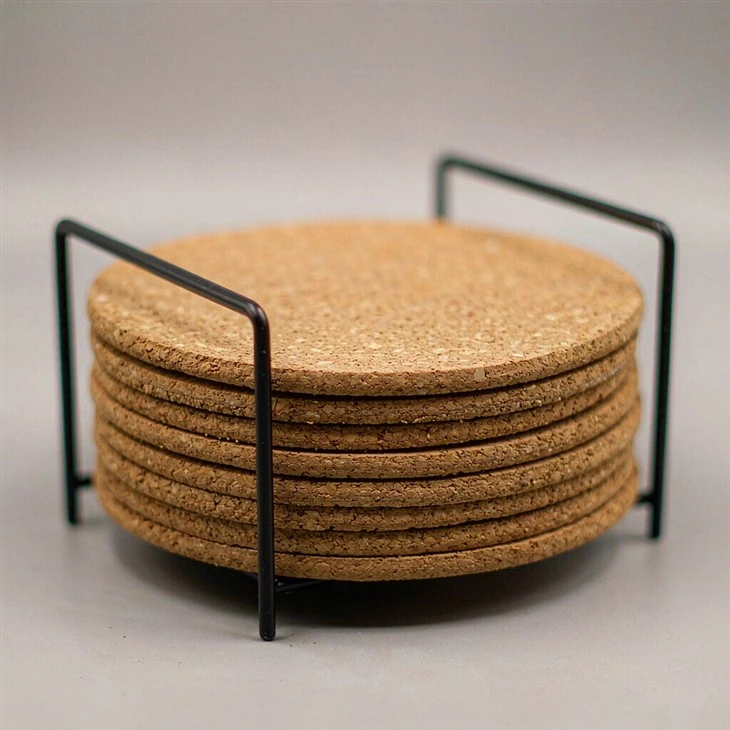


Cork Coaster with Holder — Sized to Your Glass, Not Ours
Pressed from granulated natural cork.
Cutting tolerance: +0.5/−0 mm.
Packed in a black powder-coated wire holder.
Wire holder with a 102 mm inner diameter.
Available in sets of 4, 6, or 8 coasters.
Custom logo printing before packaging.
Each set is bagged for delivery.
Description
Technical Parameters

Eight 6 mm coasters in the 52 mm holder. Inner Ø102 mm, 0.75 mm clearance per side at the tightest.
Six numbers, no scrolling
| Material | Agglomerated natural cork, granule 1–3 mm |
| Diameter | 90 / 100 / 110 mm · custom 80–200 mm |
| Thickness | 3 / 5 / 6 / 10 mm |
| Tolerance | Ø +0.5/−0 mm · thickness ±0.3 mm |
| Set | 4 / 6 / 8 coasters + black wire holder (inner Ø 102 mm) |
| MOQ & lead time | 1,000 sets · samples 7 days, bulk 20 days |
A coaster sits still. A coaster set has to stack.
That second job is where sets come back. Diameter has to land inside a tolerance the holder was cut to. Thickness has to hold across eight pieces, because the holder only has one height. Get either one wrong and the set reads cheap on a shelf, even though every coaster in it is fine on its own.
So: a dimensional product. Not a printed gift. Everything below - the tolerances, the holder clearance, the stack height - is here because those three decide whether your reorder arrives looking like the first batch.
Full parameters
| Material | Agglomerated natural cork, granule 1–3 mm. Not natural cork sheet - different performance, see the comparison below |
| Density | ≥ 320 kg/m³ - density is what decides wear and dusting |
| Diameter | 90 / 100 / 110 mm · custom 80–200 mm. Above 200 mm we quote it as a trivet |
| Diameter tolerance | +0.5 / −0 mm. One-way, upward - the holder sets the ceiling, not the caliper |
| Thickness | 3 / 5 / 6 / 10 mm. Other thicknesses need a new mould |
| Thickness tolerance | ±0.3 mm. On an 8-piece stack that accumulates to ±2.4 mm |
| Edge | Straight cut, or R0.5 mm rounded - rounding is what stops edge dusting |
| Surface | Natural / sanded / lacquered. Lacquer changes absorbency - tell us if it goes into food service |
| Holder | Black powder-coated iron wire, 4-post, wire Ø3 mm · inner Ø102 mm · height 52 mm. Takes a 100 mm coaster with 0.75–1.0 mm clearance per side |
| Set size | 4 / 6 / 8 coasters. 52 mm holder height takes 8 × 6 mm (48 mm nominal, 50.4 mm at the upper limit) |
| Logo | Laser engraving / screen print / heat transfer / hot foil - each has limits, see below |
| MOQ | 1,000 sets - the same for blank and for custom logo |
| Sample lead time | 7 days |
| Bulk lead time | 20 days after sample approval and deposit |
| Monthly capacity | 80,000 sets |
| Moisture at packing | ≤ 8 %. The reading goes on the packing list, not just into our file |
| HS code | Issued with the quotation |
On CE. Cork coasters are not in CE scope, so we do not claim CE. If your spec sheet asks for it, we will tell you it does not apply and issue the food-contact documentation that does - with your quotation, for your order.
Which size for which glass
Measure the base of the glass, not the rim. That is the number that decides the coaster.
| Your glass | Diameter | Thickness | Set | Why |
|---|---|---|---|---|
| Espresso, small cup (base Ø55–65 mm) | 90 mm | 5 mm | 4 | Leaves 12–17 mm of cork visible around the base - it looks placed, not oversized |
| Standard mug (Ø75–85 mm) | 100 mm | 6 mm | 6 | The most common combination we run, and the easiest to sell at retail |
| Pint or beer glass (Ø85–95 mm) | 110 mm | 6–8 mm | 6 | A heavier glass needs more insulation under it |
| Wine, champagne, flute | 90–100 mm | 5 mm | 6 | A thin stem is more stable on a thinner pad; a thick pad makes tall glasses top-heavy |
| As a pan trivet | 150–200 mm | 10 mm | - | Outside coaster range - quoted separately |
| You already have a holder | Inner Ø should be coaster Ø + 1.5–2 mm on nominal. Our 102 mm holder takes a 100 mm coaster. Tighter and the stack jams; looser and the top coasters tilt. Send the holder drawing and we cut the cork to it | |||
| Ordering holder with the set | Holder height is cut to the stack's upper limit, not its nominal height. Eight 6 mm coasters are 48 mm nominal and 50.4 mm at +0.3 mm each - our 52 mm holder leaves 1.6 mm, so the last one still drops in | |||
| Something else | Send your drawing. We confirm dimensions in writing before sampling, and only charge tooling after you approve it. | |||
What each option can and cannot do
| Option | Best for | Performance | Cost | What you should know |
|---|---|---|---|---|
| Agglomerated cork (this product) | Food service, hospitality, retail, gifting | Absorbs condensation, insulates, grips, quietens glass on table | Mid | Colour varies between batches - a natural material cannot be colour-matched exactly. Not dishwasher safe |
| Natural cork sheet | Premium gifting where visible grain sells | Best grain, lightest weight | High | Uneven thickness, so it cannot hold a precision stack. Raw-material supply is less steady |
| Cork + EVA laminate | Retail goods needing a stiff hand | Stiff, holds shape, does not curl | Mid-high | EVA is plastic. Once it is in there, the "100% natural" claim is gone |
| TPR / silicone | Low-price promotion, multi-colour programs | Washable, unlimited colour | Low | No natural grain, so the sustainability positioning does not hold. Heavy, so you pay for it in freight |
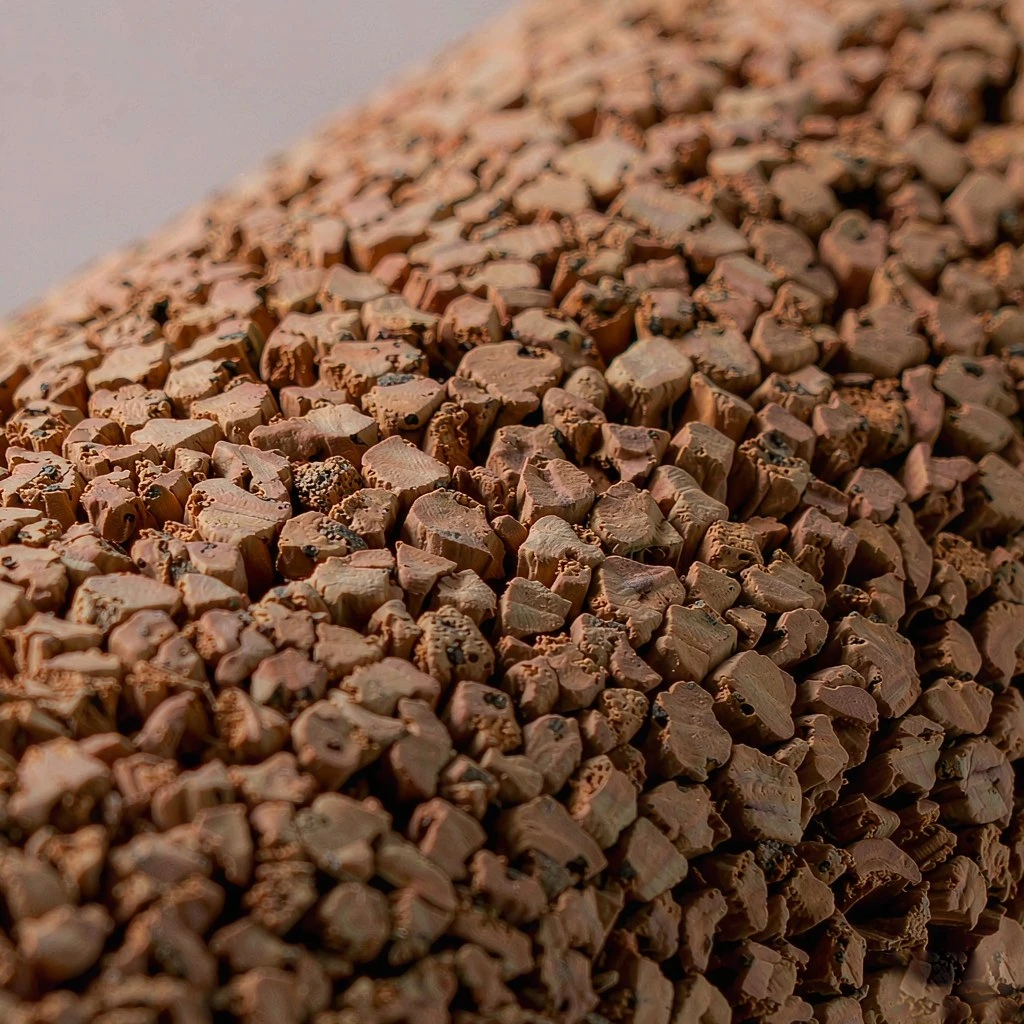
Granulate at 1–3 mm, pressed at ≥320 kg/m³. This is the texture that decides whether the edge sheds.
Four methods, and where each one fails
Laser engraving
Burns a dark brown mark into the surface. Does not rub off. Clients notice the depth - one of ours put it plainly: "Very clear and dark laser engraving."
Single colour only · lines under 0.3 mm blur together · burn depth follows density, so shade drifts between batches
01
Screen printing
Saturated colour, more than one colour possible.
Cork is porous, so large solid areas show grain through · one to two colours is the economic limit · repeated wiping wears it
02
Heat transfer
Gradients and photographic artwork.
Edges lift on curved surfaces · not dishwasher safe · unit cost climbs steeply below a few thousand
03
Hot foil stamping
Gold and silver, strong gift presence.
Wears off with handling - the most common complaint on this finish. Recommend it for gift sets, not café tables
04

Natural, sanded, lacquered, engraved, printed, and a 10 mm trivet weight - plus the two holder formats we run.
Five things that go wrong
1. When the stack leans
Diameter drift · one-way tolerance
A set comes off the line looking right. It passes the visual check. It gets bagged, cartoned, shipped, and opened in a warehouse three weeks later - and the top coaster sits visibly off-centre in the holder. Nobody photographs that and calls it a tolerance issue. They photograph it and call it a bad batch.
Diameter drift does it. Agglomerated cork is pressed and then it relaxes. The mould wears as it runs. Moisture at pressing changes how much the disc shrinks on its way out of the die.
So diameter runs one-way, +0.5 / −0 mm. The holder sets that ceiling, not the caliper. A 100 mm nominal coaster can arrive at 100.5 mm; the holder is 102 mm inner, so the tightest fit you will ever get is 0.75 mm per side. That single number is the whole specification - and it is why we say "nominal 100" and never "about 100."
How to check us: ask for the first-off inspection sheet from your order. We keep them 12 months.
0.3 mm.
2. Thickness drift, per piece - ±2.4 mm across eight
That is all one coaster may vary in thickness. Eight of them make ±2.4 mm across the stack.
Put a stack like that in a holder cut to nominal height and the eighth coaster does not go in. Nobody reports a thickness tolerance after that. They report that the holder is too small, and they are not wrong about what they are looking at.
Holder height therefore follows the upper limit of the stack. Eight 6 mm coasters: 48 mm nominal, 50.4 mm if the belt runs thick. Ours is 52 mm. The 1.6 mm that leaves is the only reason the last coaster drops in on a Tuesday when nothing has been adjusted since Monday.
The record to ask for: the stack-height sheet, filed next to the holder drawing. Both kept 12 months.
3. "Open the bag and there is dust on the rim."
Cork dusting
Straight into the drink. On a hotel tray it becomes a complaint at reception; in a retail box it becomes a return, and you pay the freight.
Three sources. The cut edge, where a torn granule keeps shedding. Sanding residue sitting in open pores. And low density, where the whole body is friable and not just the rim.
Two of those we hold by specification, not by inspection: density ≥320 kg/m³, granule 1–3 mm, so the body is bonded and not loosely packed. The third is geometry, R0.5 mm on the edge, because a square edge is a corner waiting to break off.
Did any of it work? Ten seconds will tell you.
Test it yourself: rub one of the samples on dark paper. That is the whole test, and we would rather you ran it than trusted us.
4. It is almost never the glue
Mould after a sea container
The first suspect is always the adhesive. It is almost never the adhesive.
Mould after a sea container is a moisture problem. Cork is hygroscopic: it takes water out of the air and keeps it. A container crossing the tropics cycles hot afternoons and cold nights, condensation forms inside the steel, and the cartons nearest the wall drink it first. Boards that left the plant much above 8 % already hold enough water for mould to start by day thirty.
So the number we publish is ≤ 8 %, and it goes on the packing list instead of into a file. If a container arrives damp, that reading is the first thing we open with you. If it says 7.5 %, the argument has moved from the material to the freight - where it usually belongs anyway.
Nothing to request: the reading is already on your packing list.
5. "The reorder doesn't match the first batch."
Colour consistency
We hear it often enough that colour is a range on our side now, not a match.
Cork is bark. Colour follows the tree, the plot, the harvest year, the boiling. Nobody holds an exact match across twelve months. Not us, and not the supplier who quoted you less. A range can be held - agreed before the first order and sampled, so both sides are looking at the same disc.
Each lot gets compared against that agreed reference, not against the previous shipment. Compare against the last shipment and the colour drifts quietly for a year. Nobody notices until a retailer lines old and new stock up on one shelf.
Before production: ask for a physical piece as your colour reference. A disc beats a photo every time.
What we do not have
Not a disclaimer - a list, so you do not spend two emails finding out.
-
No salt spray report for the holder.
- The powder coating is specified and the wire is Ø3 mm, but we have never run a salt spray test on this frame. If your spec sheet calls for 48 or 96 hours, we tell you we cannot document it today. The other option is sending you a number we have not measured, and we are not going to do that.
-
No food-contact certificate number printed on this page.
- Cork is not in CE scope and we do not claim CE. The food-contact documentation for your order is issued with the quotation. If that is a blocker for your compliance team, say so at enquiry stage and we will tell you what we can and cannot supply before you spend time on a sample.
-
No review count.
- There is one client comment on this page because there is one we can quote. We are not going to manufacture a rating.
-
Where these sets go
Restaurants and cafés
Laser engraving, not print. It survives commercial washing-up and print does not. Sizes from the table above.
01
Hotels and hospitality
Same coaster loose for rooms and boxed for the gift shop. Two pack formats, one specification.
02
Retail and private label
Sold by the set; engraving holds up better than print on a shelf that gets handled. Barcodes applied at packing if you send the artwork.
03
Corporate and promotional
Single-colour engraving keeps unit cost down at volume, and the holder is what makes the set survive the event.
04
Gift and hamper
Foil stamping if the box is the product. Mind the wear limit above.
05
Pack format, carton specification, HS code and compliance documents are issued with the quotation for your specific order.

A six-piece set on a café table. The holder is the part that stops the set walking off.
-
How an order runs
Step What happens Days 1 You send a drawing, a reference sample, or just the base diameter of your glass - 2 We confirm diameter, thickness, set size and holder clearance in writing 1–2 3 Sampling - a physical sample ships for your approval 7 4 You approve it, or we revise once at no charge 5 5 Deposit - T/T 30 % - 6 Bulk production 20 7 Balance 70 % before delivery; inspection, packing, documents 2 8 Shipment - Step 2 is the one worth slowing down. Every dimensional claim on this page is worthless if the drawing was never agreed, and a two-day confirmation is cheaper than a container of sets that do not fit a holder we did not know about.

Step 7, in one frame: the eighth coaster going in against the posts, with the drawing beside it.
Xi'an, Shaanxi - 22,000 m² under roof
Fifteen-plus production lines, cork products since 2007, 40+ export countries, 80,000 sets a month. All of it open to a video walk-through before you place a first order - ask and we will set a time.
These four are shot on site, not generated - a plant photo is the one thing a render cannot fake. The stack-height check that used to sit here is now the photo in the process section.
One comment, quoted as received
"Very clear and dark laser engraving. Good details. Rapid turnaround."
Attribution withheld by request. No rating, no review count, no aggregateRating in the structured data.
Watermark-free product images available on request - retail and private-label clients need to use them in their own listings, and a third-party watermark makes that impossible.
Questions buyers actually ask
1. Which diameter should I pick for my glasses?Measure the base, not the rim. A 100 mm coaster under a mug with a 60 mm base leaves 20 mm of cork showing all round, which reads as deliberate. The same mug on a 120 mm coaster reads as a placemat. If you are unsure, send the base diameter and we will tell you what we would run - that is a two-minute answer, not an enquiry.
2. Do the coasters have to match the holder exactly?The holder needs 1.5–2 mm of clearance over nominal diameter, or the stack jams. Our standard holder is 102 mm inner diameter for a 100 mm coaster, which gives 0.75–1.0 mm per side. If you already have holders, send the inner diameter and we cut the cork to it.
3. Can I mix sizes in one set?One diameter per set. Mixed diameters do not stack cleanly in a single holder, and the set looks wrong even when each piece is right.
4. What is the MOQ?1,000 sets, the same whether the coasters are blank or carry your logo. Below that we can sometimes fill from stock - worth asking rather than assuming it is a no.
5. How long for a sample, and how long for bulk?Samples 7 days. Bulk 20 days after sample approval and deposit. They are two different numbers, and if you have a launch date, plan against the second one plus shipping.
6. Why is there a price range instead of a price?Because six things move it: diameter, thickness, density, set size, holder and logo method - before quantity. The range is US$0.35–2.20 per set across three configurations, and we will tell you which of the six is moving your number most.
7. What are the payment terms?T/T, 30 % deposit, 70 % before delivery.
8. Which logo method should I choose?Laser for durability and one-colour marks. Screen print for solid colour at low cost. Heat transfer for photographs and gradients. Hot foil for gifting only, because it wears with handling.
9. What artwork do you need?Vector - AI, PDF or CDR - at final size. Raster at 300 dpi minimum. For engraving, keep the thinnest line at 0.3 mm or above or it will fill in.
10. Is it food-contact compliant?Cork is not in CE scope, so we do not claim CE. The food-contact documentation that applies to your order is issued with the quotation. We would rather give you the document that exists than the certificate name that sounds reassuring.
11. What happens if the goods are wrong?Tell us within 30 days of arrival. Once we have verified it, the next order ships with replacement stock or the invoice is credited. We have not set a minimum value below which you have to post the goods back - ask us at quotation stage if that matters to your process.
12. Will you be late in peak season?August to November is our peak. Place orders 45 days ahead to lock capacity. If your date is fixed, tell us at enquiry stage and we will confirm capacity before you commit - that is a different conversation from confirming it after you have committed.
Hot Tags: Cork Coaster with Holder — Sized to Your Glass, Not Ours, China Cork Coaster with Holder — Sized to Your Glass, Not Ours manufacturers, suppliers, factory, Cork Table Mats, Cork Coasters Round, Coaster Round Cork, Cork For Coasters, Cork Coaster With Holder, Cork Mat Size
Previous
Cork Coasters RoundSend Inquiry


